
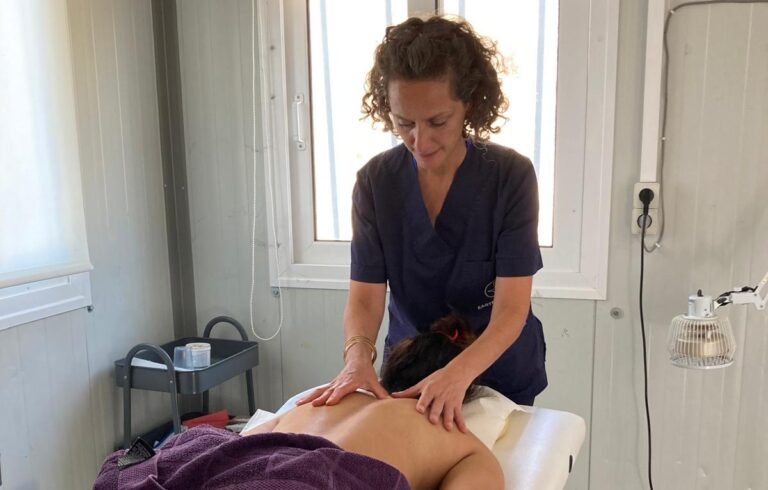
Acupuncture for Fertility: A Conversation with Houri Alavi
When I first discovered acupuncture, it was a lifesaver.
My original acupuncturist helped me tackle crippling anxiety, regulated my stress response, and support me through various health challenges. It was transformative. But when my fertility journey began, I knew I needed someone who specialised specifically in reproductive health, someone who understood the unique complexities of trying to conceive in your 40s while managing IBD.
That’s how I found Houri Alavi.
Houri was recommended to me by someone who’d had successful results on their own fertility journey. She became an essential part of my fertility team and eventually supported my IVF journey. Her expertise in fertility acupuncture, combined with her deep understanding of how stress, hormones, and body systems interact, made all the difference.
But Houri was more than just my acupuncturist; she became my therapist, my cheerleader, and someone who truly saw me as a whole person, not just a collection of hormone levels and scan results.
I sat down with Houri to have an honest conversation about what acupuncture can actually do for fertility, particularly for women over 40, and to demystify this ancient practice that’s become increasingly popular in modern fertility treatment.
The science behind the needles
Let's start with the science. How does acupuncture actually support fertility?
Houri: “Great question. What we know from modern science about acupuncture, which is still being researched, is that it can help in many aspects of fertility.
By inserting needles into acupuncture points, there’s a modulation of the nervous system. Signals are being sent, and neurotransmitters such as dopamine and serotonin are being released, which have a beneficial modulating effect on the nervous system.
We also know that acupuncture helps release endorphins, which help us feel more relaxed and calmer. That feel-good factor is great when we’re trying to conceive.
Acupuncture also affects microcirculation and vasodilation. By inserting a needle into acupuncture points, the blood vessels dilate, and we have better blood flow. With better blood flow, healing happens more quickly, and nutrients and neurotransmitters are transported in a more effective and efficient way around the body.
We also know it helps modulate the immune system. There are many different layers, but as I said, it’s still being researched.”
She went on to explain how the ancient Chinese wouldn’t have had access to this scientific information when they were seeing benefits from acupuncture. They’d been writing it down for thousands of years, using a completely different model of understanding the body.
Houri: “We look at it from an ancient Chinese or Far East Asian perspective. For a woman trying to conceive, we consider the menstrual cycle in a lot of detail — asking about the length, flow, consistency, color, and duration. We look at each stage from a yin/yang perspective, where the period is a yin phase, and approaching ovulation is a yang phase. We’re coming at it with a different set of glasses and different language to explain what’s going on.”
For me, this integrated approach was crucial. Every time I left a session with Houri, I felt more relaxed. And she wasn’t just treating my fertility — she was managing both my fertility journey and my IBD simultaneously.
Houri: “That’s one of the beauties of this integrated approach to health. There is no separation between the different systems, between the physical, mental, and emotional levels. We’re looking at the individual, at their terrain, at what’s going on in all their systems. A woman might come for regulating her cycle, but her sleep might also improve, or her digestion. Everything is interlinked.”
The 40+ reality: What we're actually up against
Women over 40 face unique fertility challenges. What specifically can acupuncture address for this age group?
Houri: “It’s an increasing group of patients I see, older age groups coming through. Acupuncture can’t reverse ageing, unfortunately. We haven’t quite got to the fountain of youth yet. But what we can do is really help optimise the environment, the reproductive environment.
We can’t necessarily reverse the clock on the age of an egg, but what we can do is make sure that the follicle is growing as well as it can and is released in a timely way, in a beautiful environment that’s receptive. Those are the things we can specifically focus on.
Some changes women over 40 might experience, and this is all examples and averages, we treat on an individual basis, might include a thinner lining. So that becomes a focus for acupuncture treatments, to support endometrial receptivity and make sure the quality of that lining is as good as it can be.”
This hit home for me. At 38, then pushing 40, I was hearing “geriatric pregnancy” and “advanced maternal age” thrown around like my body had an expiration date. Houri’s approach was different, focused on what we could optimise rather than what we’d lost.
Me: “I think what you touched on earlier about triggering hormones and creating overall relaxation, that would lower cortisol levels, which helps improve egg health and has all those knock-on effects.”
Houri: “Absolutely. And hormones such as FSH and LH, we know that acupuncture works on that hypothalamic-pituitary-ovarian axis. We know that with age, those hormones are more likely to be doing a different dance, so acupuncture can really help on that axis. We can’t isolate a hormone, but we can help regulate the hormones, whether women are on an assisted cycle or not. You often see the benefits of changes in hormones after some acupuncture.”
I know I did.
What changes do you typically see in your patients over 40?
Houri: “We see their cycles become more predictable. There’s more consistency between the follicular phase, ovulation, and the luteal phase. We might have clearer signs of ovulation, more cervical mucus. If a woman’s been prone to spotting or heavy bleeding, we see that normalising.
We often see a thicker lining. And not just on a physical level, but on a mental and emotional level, some of the highs and lows women experience in a cycle, which women over 40 might be more prone to, we see those evening out. In terms of frustration or sadness, hot flashes, night sweats, there are all sorts of benefits we see, sometimes just after one or two treatments, really.”
I experienced these changes throughout my journey: increased cervical mucus, more regulated cycles. And the emotional support was crucial.
Me: “One of the things women face when trying to get pregnant over 40 is the stress of trying to get pregnant over 40. There’s this immediate resistance: ‘Oh no, it’s gonna be difficult. It’s gonna be hard. You can’t do that.’ So you’re helping women manage the emotions when they’re pushing back against negative energy coming at them from other areas.”
Houri: “Absolutely. We also see things like sleep patterns becoming deeper and more regular, so that a woman feels better in herself, managing those challenges.”
Acupuncture and IVF: A powerful partnership
How does acupuncture work alongside IVF?
Houri: “This is an area where there is actually a lot of research, specifically around different phases in the cycle and the outcomes acupuncture can have. While more research is always needed, this is one where there are quite a lot of positive outcomes for acupuncture, particularly around embryo transfer.
But I like to see women all the way through a cycle, ideally in preparation for an IVF cycle, just to prepare the body because it’s about to undergo some big changes. Through an IVF cycle, we might see women if they’re down-regulating during that phase to support the body with that process. But also, if there are any negative side effects from medication, acupuncture can help support that.
I might see women 2 or 3 times while they’re in the process of stimulation. I like to base things on outcomes of scans and bloods, and incorporate timed treatments. When can we best support you, at what point in the cycle?
For instance, if a woman produces lots of follicles but they’re of differing sizes, that’s a really good time to have acupuncture because it can help bring things into a more even place.
I ideally like to see a woman on the day of her transfer, whether that’s donor eggs or frozen embryos, whatever it happens to be, as close as possible to the time of transfer. That’s where there’s a lot of really positive research. And then post-transfer to support, in that 2-week period, I like to see women a few days after transfer, supporting them all the way through until their pregnancy test and beyond.”
I saw Houri on the day of my transfer and afterwards. And it was really important for me because progesterone triggers my bowels. So seeing Houri when I was going through the phase of having injections and pessaries helped keep my bowels calm and on an even keel.
Me: “I know it’s actually been said to me within fertility clinics, they give women as much progesterone as they think they can handle. They throw it at us. I’ve spoken to women who’ve been through IVF, and progesterone actually triggers depression, and women at that stage have struggled with their mental health. I think acupuncture at that point is really important because it helps with mood.”
Houri: “Very much so. That’s the beauty , it can really support during quite medicated cycles where the clinics can’t reach. Hopefully, the acupuncture can, in terms of that level of support. And it’s not one-size-fits-all with acupuncture. It’s very personalised, so every nuance of your bowels, or your sleep, or your mood, that is of significance to us.”
Real stories, Real hope
Can you share an inspirational story?
Houri: “Oh, so many to share at various stages of trying to conceive. One that really stands out has to be a woman whom I treated in her late 30s to try to conceive. She was trying naturally, and it wasn’t happening, so she and her partner decided to go for IVF. Unfortunately, that wasn’t happening for them either.
So she decided to go for donor egg, and she conceived once, gave birth to a beautiful baby. Conceived twice, gave birth to another beautiful baby. And then 2 years later, conceived naturally.
Just phenomenal. She had acupuncture all the way through, before trying naturally, before IVF, before donor egg, and then finally conceived a third child naturally after all of those attempts. That was quite phenomenal, and just a testament to what the body is capable of. You never know what’s going to happen.”
Me: “You hear a lot about people who stop trying and then fall pregnant.”
Houri: “There’s a lot going on at the time, so it’s very difficult to pinpoint why. Pregnancy is so complex. Achieving pregnancy, maintaining pregnancy, it’s all so complex. So many factors, many of which the medics are also not sure about. It’s really about finding what’s the right fit for the person, the individual, what level of support they need, where are they going to get it from?”
Finding the right practitioner
What should somebody look for when they're looking for an acupuncturist?
Houri: “They need to look for an acupuncturist who has had the training and the experience, because acupuncture is not a protected title. We’re not statutorily regulated. We’re regulated by our own professional bodies, but anyone can call themselves an acupuncturist, so you have to be careful when choosing a practitioner.
Make sure they’re covered by, for example, the British Acupuncture Council or the Association of Acupuncture Clinicians. I’m covered by the British Acupuncture Council and the Professional Standards Authority. We have professional, ethical, safe practice codes, and we have a minimum of a 3-year degree-level education and experience.
Many of us have gone on to do post-graduate qualifications in specialisms like fertility or pregnancy-related work. So please make sure that when you look for an acupuncturist, they are professionally qualified.
Ask them what their experience is. Have a chat. I always think it’s really useful to have a chat with someone, sound them out, see if you like the sound of them, will you get on, how do they work. There are many different ways of having an acupuncture treatment, some people stay in the room, some insert the needles and leave. Find out how your prospective practitioner works.
Most of my patients come from word-of-mouth referrals. Just have a good old chat and make sure that you will get on and that they can support you in the way that you need to be supported.”
I remember my first conversation with Houri on the telephone, we went through it all, answering questions, making sure we were both on board.
Houri: “It’s about both of us being on board. At some point, you’re going to need weekly treatments, and at some point, monthly. At some point, you might need twice weekly, depending on the cycle. It’s a massive investment, financially, mentally, emotionally, time, in every aspect. So we both have to be on the same page. We want to get the best outcome.”
I remember flipping from weekly to biweekly to monthly and back again throughout my journey.
Houri: “I also hope I treat people as equals. Some people might be taking medication or going down a path that may not be my choice, but that’s not what I’m there for. I have to be professional, and it’s about: can you work with that person? Can you meet them at that level, whatever they’re going through? No judgments made.
If people start saying, ‘Ooh, I wouldn’t do that. Ooh, I don’t know’, then you’re like, ‘Have I got your trust?’ That’s a bit of a red flag.”
The one thing you need to know
What's the one piece of advice you would give a woman in her 40s starting her fertility journey?
Houri: “Big hugs.
I would say: learn about your body. Learn about what it does, what it likes, what it doesn’t like. Go with that. Trust that.
Find out about different perspectives on ways forward. Get second opinions and third opinions and research. There’s no magic pill or magic bullet, I’m afraid. It’s very much about what suits you.
Absolutely, get information from your friends or support groups, but in the end, it’s about what are you prepared to go through and how is it going to make you feel? Be comfortable with that.
And as many acupuncturists might say, it’s all about balance. It’s all about yin and yang. Make sure that all the doing, all the foods you’re eating, the exercise, making sure everything you’re doing is right, balance it out with some yin stuff. Balance it out with some quiet stuff, with some stillness, with some non-judgmental stuff, with the non-doing as well.”
My reflection
I definitely echo everything Houri said. I spent a lot of time on my journey noticing what worked, what didn’t work, what my body liked, what it didn’t like, and what it missed.
You know your body better than the clinic will know your body. I really believe that. How you respond, you can feel it.
Looking back, acupuncture with Houri was about more than needles and Traditional Chinese Medicine theory. It was about having someone in my corner who saw my body as capable, who treated me as a whole person rather than a collection of hormone levels, and who gave me tools to manage the stress that was literally making my IBD flare and my cycles disappear.
Did acupuncture alone get me pregnant? No. But did it play a crucial role in preparing my body, regulating my stress response, supporting me through IVF, managing my IBD during the most hormonally chaotic time of my life, and giving me a fighting chance? Absolutely.
For anyone on this journey, especially those of us over 40, I can’t recommend enough finding a fertility acupuncturist who really knows their stuff. Not as a replacement for medical intervention, but as a powerful complement to it.
Your body deserves every tool in the toolbox.
Find Houri: hourialavi.com
Important Disclaimer: The information shared here is based on personal experience and professional insights, but it is not medical advice. Acupuncture is a complementary therapy that works differently for everyone. Always consult with your qualified healthcare provider before starting any new treatment, especially when dealing with fertility or hormone-related health concerns.