
Let's Unpack the Question: What About Donor Eggs?
I wanted to pause the story for a moment and open the conversation about donor eggs. The number of people using donor eggs is increasing, and I think the number of conversations around it needs to increase too.
So it’s no surprise I chose donor eggs – it’s written right on the introduction page of this blog. But it’s a loaded question, especially depending on where you are on your journey.
You could be in your twenties, trying to come to terms with premature ovarian failure. Maybe you’ve been trying for years. Maybe you’ve been trying for years with your own eggs unsuccessfully, so you’ve tried adoption and were rejected. Perhaps you already have a child with your own eggs, so you chose donor eggs because you’re over 40 and they have better success statistics.
Wherever you are, whatever you’ve been through, the decision to go with donor eggs can be hard. Traumatic, even.
It usually comes with the need to come to terms with the loss of a fundamental part of you – whether you’ve been diagnosed with POF or your own eggs aren’t bearing fruit. Many of the questions you have aren’t related to the process of using a donor egg. They’re personal. They’re emotional. They may not even be about you.
You’re trying to work through your feelings about where you are. You’re reaching for acceptance.
The questions that keep you up
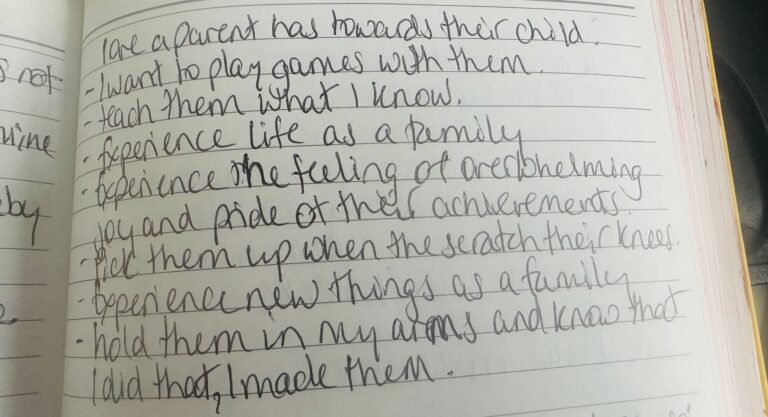
A lot of mine were about how I’d bond with the baby and how the baby would bond with me. At that point, I didn’t even consider that the first round of IVF wouldn’t take.
Would I bond with the baby?
Would the baby bond with me?
Would it be as it would’ve been with my own egg?
Would I feel the same way as other mothers do?
Would I still have that same maternal connection?
What would it do to my relationship with Marco?
What if I don’t bond with the baby, and Marco leaves me?
Would the baby look anything like me?
Would the baby feel like my baby?
The list went on.
And all the time, I was coming to terms with the fact that my window had closed – slammed shut.
I seemed to have landed straight into menopause.
Feeling past it
I felt old. Past it. Put out to pasture when I had so much more life to live.
Marco and I hadn’t been together long. It hadn’t even been two years before we started trying, before I was ill. And we’d been on this rollercoaster for nearly three years by this point – which, I know in terms of fertility journeys, isn’t long compared to some.
The birth and the bond
I’ll get to it in a couple of chapters, but the birth didn’t go as planned. Which was fine, but it was one of the scenarios I wanted to avoid because I was worried about how it would affect my bond with my baby.
The baby was placed on my chest, and I didn’t feel the rush of hormones I was expecting.
I know now it was down to the situation. In that moment, while I was holding the baby on my chest, there was a lot of other stuff going on, along with my expectations and me dissecting my reaction.
When I was on the ward with my baby on my chest, Marco by my side, all those bonding questions and worries simply melted away.
Every burble. Every stretch. Every rub of the face. Every move made me love them more and more.
One of my favorite photos is of our baby lying on Marco’s chest in the hospital, both of them sleeping. In that moment, I thought my heart would explode.
And I’ve had so many of those moments since. So many moments that I wonder why I was even worried in the first place.
But that doesn’t minimise the importance of those questions.
The question I never said out loud
One question I never said out loud – because it felt disloyal even thinking it – was whether I was interchangeable.
If another woman could provide the egg, what exactly made me the mother?
It took me a long time to realise motherhood was never a single biological moment. It’s a relationship built over thousands of ordinary ones.
Something I didn't understand then
And something I didn’t understand then – something I only learned much later – is that using donor eggs doesn’t mean you are somehow biologically separate from your baby.
The DNA may begin elsewhere, but pregnancy is not passive.
Your body isn’t just carrying a baby. It’s shaping one.
Throughout pregnancy, your hormones, your immune system, your nutrients, your rhythm, and your environment all influence how genes are expressed and how that tiny human develops.
Science calls it epigenetics, but really it means this: your body teaches the baby how to grow.
You regulate their world before they ever see it. You build the environment that their brain, metabolism, and nervous system learn from. Long before birth, there is conversation happening between mother and baby at a cellular level.
My body was still part of the story. Deeply, actively, undeniably so.
I wasn’t stepping outside the biology of motherhood. I was living another version of it.
The connection I worried about
So that connection I was worried about? Worried about whether or not they’d look like me? I still have a huge hand in that, even before they were born.
Now there’s nature versus nurture, and Marco is always telling me they’re stubborn like me. Although I tell him they’re stubborn like him.
Where it all led
The journey, the questions, the uncertainty – they all took me, us, to one place.
And now, I wouldn’t change that for the world.
If I could sit beside the version of me Googling donor eggs at 3am, I wouldn’t give her statistics or reassurance.
I’d just tell her this: Love doesn’t arrive all at once. It grows quietly, in the repetition of care, until one day you realise it was never missing.
The questions didn’t disappear overnight. Some still visit occasionally, usually at 3am.
But they don’t carry fear anymore.
Just curiosity about how many different ways there are to become a family.