Chapter 8 - The Question That Breaks You
When we first received the response “menopause” from the fertility consultant and his refusal to do anything about it, I just couldn’t comprehend it.
Both my mum and maternal grandmother suffered badly with menopausal symptoms. Apparently, as women, we need to look to our mothers for clues about our own experience. So surely it followed that I’d be suffering too?
Where were my symptoms?
I was paralysed. For the first time in two years, I didn’t leap into action, any action.
I was crushed. The hope I’d carried vanished.
The fight I’d had in me, the determination, the resilience – gone.
I was momentarily silenced.
And there were tears. So many tears.
Finding my voice again
It took me a few hours before I picked myself back up, before I spoke again. Which, if you know me, is unheard of.
I’m tenacious and as stubborn as an ox. Sometimes it’s a blessing, sometimes a curse.
When you’re on your fertility journey, you need to be both. You need equal parts boundless hope, relentless tenacity, and rock-hard resilience. Because this is the reality of the journey.
You have to hope for a positive outcome because negativity is counterproductive.
You have to be tenacious because if at first you don’t succeed, you need the courage to try again.
You have to be resilient because when you don’t succeed, you have to pick yourself up and dust yourself off.
And YOU have to pick yourself up. People can support you, but ultimately it’s down to you. Because then it starts all over again.
Until it doesn’t.
On top of it all, you can’t (or shouldn’t) get stressed because that’s counterproductive too.
It’s exhausting.
Reaching out
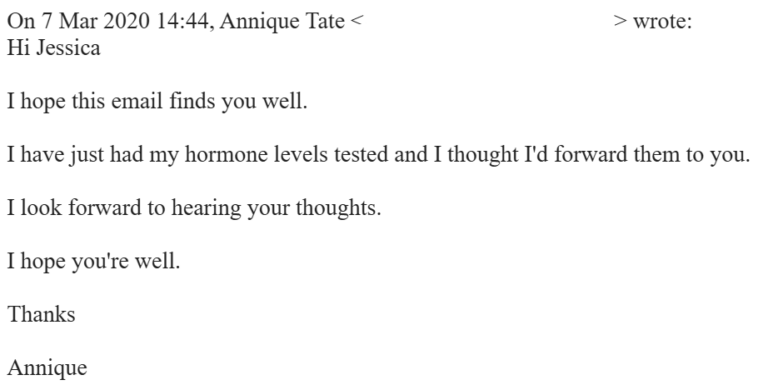
I pulled myself together a few hours later and took to my keyboard to contact Jessica.
Four hours later:
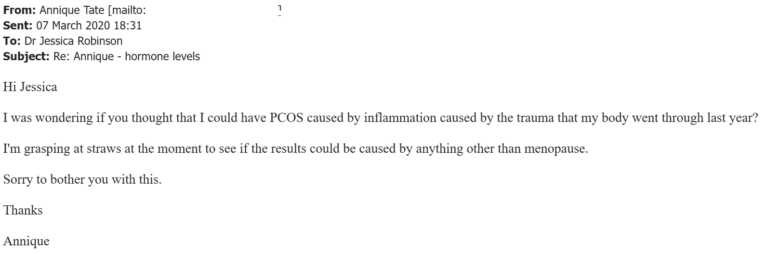
This was Saturday.
On Monday, PM Giuseppe Conte imposed lockdown across Italy.
The research rabbit hole
This was before ChatGPT existed. You couldn’t type in a prompt and have it collate research and data along with possible reasons, so you could evaluate it all. It was manual Google searches, endless tabs, collating information, cross-referencing sources, dismissing the mythical nonsense.
At times, trying to understand what was happening to my body when those who were supposed to help me, dismissed and wrote me off, was exhausting. This type of information wasn’t in my wheelhouse. I considered amenorrhea, but I didn’t fit the profile.
Sidenote: I’m still fighting to get my hormones sorted out, but I have ChatGPT on my side now. Although I’m definitely in menopause now, that’s not the issue I’m still fighting to resolve. Anyway, I digress.
Jessica, as always, was amazing. She responded promptly and sourced a remedy to start stimulating my ovaries. It was posted out to me a couple of days later.
It hadn’t been long since my last virtual appointment with her. She’d sent a new remedy to my brother’s place, which I’d picked up during Grandad’s funeral.
Like Houri, Jessica is the type of person you want in your corner. Someone who works with the information at hand to present informed options honestly, without an agenda.
Lockdown life
Lockdown hit Italy hard. Strict. The only times people were allowed out were for essential supplies, emergencies, and to walk the dog.
There were a lot of people out walking stuffed dogs.
That thing I used to do to work through problems, to get out of my own head, to find stillness (ironically) – running – was off the table. I couldn’t go out and pound my anger and frustration into the streets.
But here’s the catch: too much or too intense exercise isn’t good for fertility either. The fertility journey is like walking a tightrope. So maybe not being able to take my aggression out running wasn’t entirely bad.
HIIT became my thing. It didn’t have the same effect, but it was better than nothing.
We were trapped.
My lifestyle slipped over the following weeks. A glass of wine or two in the evenings. I was teetering on the edge of “what’s the point?” while taking longer than usual to pick myself up.
Work kept me busy, and I was glad of the distraction. My clients didn’t ease up when the UK lockdown hit. Two-thirds sold digital platforms and tools, so they simply adjusted to remote working. The others concentrated on marketing to minimise COVID’s impact and hit the ground running when lockdown lifted.
The certainty no one wanted to hear
I was still certain I wasn’t in menopause. I mean, where was perimenopause? What happened to that? But I couldn’t get the people I needed to listen to actually listen.
GPs (apart from the Italian family doctor) were concentrating on only ONE hormone. They were looking at my reproductive system and my digestive system separately. No one would join the dots and consider the impact one was having on the other, despite my constant protests.
It’s well-known that they impact each other.
At the time, I didn’t realise how right I was. And I’m still having a hard time getting them to listen, but I have technology on my side now.
I also didn’t understand yet that doctors in fertility clinics weren’t the right place to seek answers. They’re not fertility specialists – they’re specialists in getting you pregnant. If you have complications outside that remit, they don’t know.
Everywhere I turned, I was being dismissed because I was over 40. Apart from Jessica and Houri, everyone wrote me off based on my age alone.
I’d never faced this type of prejudice before, and I never expected it from medical professionals.
I felt powerless.
Waiting for hope
I was hanging out for the remedy from Jessica. It was taking ages. Hope was fading that it would make it through the COVID postage chaos.
Being stuck in Sicily had its perks. In April, the weather was good. We had a roof terrace, so I frequently did yoga in the sun, relaxing and embracing not being able to do anything while still needing to move my body.
At the beginning of April, I emailed Jessica to find out the medication’s name to see if I could source it locally. I couldn’t, not in the right strength anyway, and Jessica was hesitant for me to take a higher dosage.
I’d just about given up hope and was arranging for Jessica to send them again when they arrived. It had taken them six weeks to navigate through the postage chaos. I was just happy they made it. It would have cost more than £20 to send them again.
By then, I’d kind of, sort of pulled myself up by my bootstraps by resigning myself to sitting tight. I was having the odd glass of wine, but not beating myself up about it.
The arrival of the tablets gave me a second wind. I started taking them with everything else I was doing to “optimise” everything.
Like everything, results don’t happen overnight. I didn’t get the miraculous recovery I was hoping for.
In the weeks after lockdown eased, I avoided close contact with nearly everyone. I didn’t want COVID in the mix of potential fertility disruptors. The medication started to kick in, my boobs started hurting, but I wasn’t pregnant. I had all the symptoms and mood swings you’d expect from a cycle, with painful boobs on top, but still no sign of my period.
The decision I didn't want to face
We were supposed to head back to the UK mid-May. The people who’d rented our room had bailed the week before the UK lockdown. But I didn’t want to return yet. We’d come to spend time with Marco’s family and had just spent two months isolated from them. So we delayed our return.
I did a lot of soul-searching in those weeks. I was battered, bruised, had sore boobs, and contrary to the UK GP’s remark, wasn’t pregnant.
What was my best path forward? Was there even a path?
My mum introduced the idea of a fertility clinic in the UK that someone we knew in her 40s had used successfully with her own eggs. This was an option. I could get a second opinion and take it from there. The medication Jessica had given me had an effect, so maybe a second opinion couldn’t hurt.
That led to one of the biggest decisions I’ve ever had to face:
What am I willing and happy to do to have a child?
The question that breaks you
It seems like a simple question. It’s not.
The pain and turmoil it brings are inexplicable.
IVF? Obviously. I’d already accepted that.
But donor eggs?
Adoption?
The question itself was overwhelming because it meant I had to come to terms with something brutal: no matter how hard I fought, it might not happen. My mind was willing, but my body wasn’t cooperating.
At some point, I was going to need to let go. And letting go isn’t something I do easily – to my detriment.
When was I going to stop fighting? How far was I going to push it? What was I willing to try before I accepted that I couldn’t have a baby from my own egg?
I had to accept being old before being old. Women need to; it’s an inbuilt part of perimenopause and menopause. I’ve read that we’re one of only two species where females have a finite fertile window, because when it closes, our role shifts to helping the younger generation care for their young.
It’s a beautiful reason. But not remotely helpful when you’re facing this reality.
The donor egg question
I was resistant to using donor eggs initially.
Before I met Marco, I never wanted to be pregnant. So why would I want to be pregnant when the baby wasn’t mine? Wasn’t from my egg?
How was I going to feel when the baby was born? Would I have that bond everyone talks about? Would my love for them be the same as a mother whose child is from her own egg?
Would the baby connect with me? Love me in the same way? Or would the chemistry be different?
Would they look anything like me?
The adoption question
Adoption? Marco wanted kids – his kids. He still had time. Plenty of time.
He didn’t need me to have kids. He could find someone else who’d give him his children. Why would he want to go through all this when it could be easier with someone else?
The breaking point
That question – What am I willing and happy to do to have a child? – had reduced me to pieces.
I remember sitting on a bench outside his family home, bawling my eyes out down the phone to my Mum and then to one of my best friends who’d just recovered from battling COVID for ten weeks. I was babbling incoherently. I couldn’t go inside the house. Internally, I was falling apart, battling with a question I really didn’t want to face. I couldn’t go in and pretend to be normal, smile and laugh.
A few days later, I offered Marco a way out.
I thought I was being fair to him. When I told my friend, he told me off. Marco and I had been through so much over the past year with my illness and everything else, and we’d stood together. That offer belittled that.
Obviously, Marco didn’t take it. We’re married now.
Marco's answer
I asked Marco what he wanted to do.
“I’m happy with whatever you’re comfortable with,” he said. “We can try until you want to stop. We can do donor eggs. We can adopt. Just as long as it’s with you.”
I cried some more. And more.
Side note: I know I’ve probably tested that sentiment over the years because the road didn’t get easier from there. I had a lot more fight left in me. But I can say now that although it was hard – brutally, impossibly hard – I’m fully in love with the outcome.
Moving forward
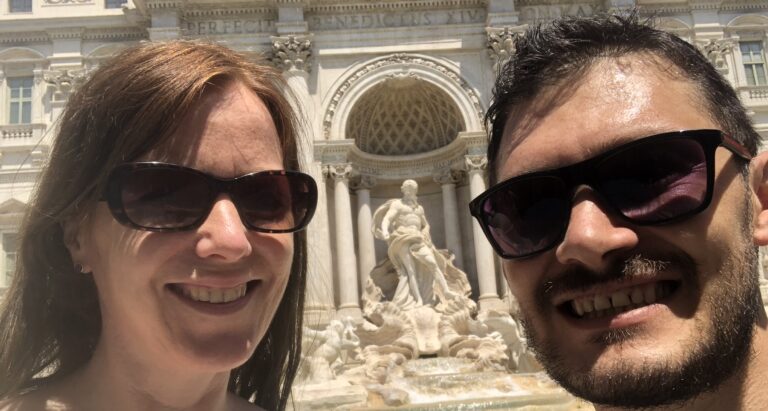
We decided to contact the fertility clinic in the UK. We were going to head back at the beginning of July after taking advantage of experiencing Sicily and Italy without tourists. We even took a trip to Rome.
We booked the virtual open day and an initial consultation for June 30th, 2020.
The rollercoaster wasn’t done yet.
I wasn’t done yet.